SPOKANE, Wash – Thousands of people will head to Spokane parks to celebrate the Fourth of July. Most won’t stop to think that the parks they’re enjoying are part of a legacy created 135 years ago.
Spokane’s first park was created in 1891 because of a gift from J.J. Browne and A.M. Cannon.
They donated 10 acres in the middle of what is now Browne’s Addition to create a city park.
It began an enduring legacy about the importance of parks and open spaces.
“They realized with all that smoke downtown and all the noise, the mills and the train depot… the streets were not sanitary, [so] they needed to do something,” said Lynn Mandyke.
Mandyke grew up in Spokane and went on to work for the city’s parks department for 20 years. She’s studied the history of the park system and how it’s developed.
The first city parks were developed in those early years, including Corbin Park on the city’s north side, what is now Manito Park on the south hill, Liberty Park just east of downtown and the what was later named Natatorium Park, across the river from what is now Spokane Falls Community College.
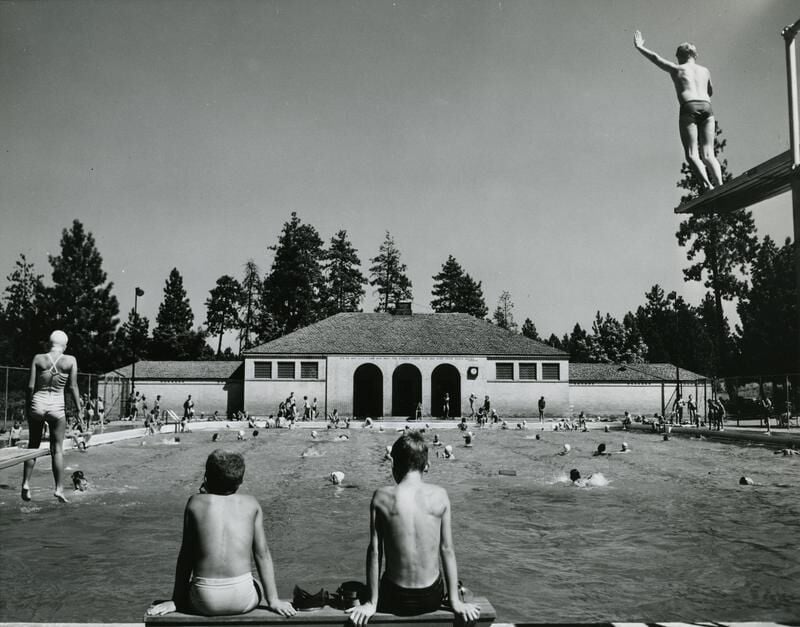
Natatorium Park was grand, with amusement park rides, an indoor pool and even a baseball field once visited by Babe Ruth.
Spokane’s love of parks was just beginning when the newly formed Parks Commission had a bold idea.
“Their mission was to hire the Olmsteads to prepare a plan for the parks system,” said Mandyke.
Contrary to a popular Spokane wives’ tale, it wasn’t Frederick Olmstead, the man who designed Central Park, who designed the parks in Spokane.
Instead, it was his sons John and Frederick, Jr. who traveled to Spokane to create a plan to move forward.
The renowned landscape architects were already working on park plans for Seattle and Portland. Park Board President Aubrey L. White spearheaded the effort to get the Olmstead Brothers to create a plan for Spokane.
“To have that legacy for the Olmstead Brothers to come to Spokane and do that plan for us was massive,” said Garrett Jones, current Director of Spokane Parks and Recreation.
The Olmstead plan called for upgrades and changes to the parks already in place. For example, they recommended city leaders get rid of the zoo in Manito Park. They also suggested smaller neighborhood parks and boulevards to connect parks and open spaces throughout the city.
“It is recognized that public baths and public gymnasia conduce greatly to the health, morality and well being of the people,” the Olmsteads wrote in their Spokane plan. “Whatever increases the general health of the public also tends to improve the morality of the public.”
The Olmstead plan recommended ballfields and playgrounds, along with swimming pools and natural gardens.
They leaned heavily on suggestions to prioritize the land along the Spokane River through downtown and downstream towards the Bowl and Pitcher. By this time, much of that land had been taken over by railroad yards and commercial development.
“Spokane should certainly preserve what beauty and grandeur remains of its great river gorge,” they wrote.
It would take decades for Spokane to realize some of the dream of the Olmsteads’ plan for what they called Gorge Park.
“Gorge Park is actually the inspiration for Riverfront Park,” Mandyke said.
Spokane Parks still leans on principles from the Olmstead plan as they grow and develop new parks and open spaces. One principle remains strong: to have parks and open spaces within walking distance of every person in Spokane.
“All these concepts aren’t new,” Jones said. “You go back to the Olmstead report over 100 years ago and the value they saw in that each neighborhood should have their park and open space, that hasn’t changed.”
Changes in Spokane parks have reflected growth in the city. Spokane will break ground later this summer on Meadowglen Park in the Indian Trail neighborhood.
It’s the city’s first new park in 23 years, made possible, in part, because voters approved the Together Spokane levy earlier this year.
Progress over the decades has also destroyed some of what the Olmsteads and early city planners had built.
Liberty Park, for example, was once a grand park on a terrace just east of downtown. It was the site of Spokane’s first playground and a grand promenade and waiting pool.
Over the years, a large lake in the park was filled in. Then, in the 1970s, Interstate 90 was built, cutting right through the large park.
The old promenade was reduced to crumbling towers of basalt rock you can still see just north of I-90. The other half of Liberty Park is the park we know today.
What started with one park 135 years ago has now grown to something the Olmsteads never could have imagined.
Through all the changes, the value of those parks remains.
“When you see a family, whether they’re picnicking in the park or playing on a playground, that is the biggest pat on our back.” Jones said. “I think it’s just the sentiment of the community that – parks matter.”
COPYRIGHT 2026 BY KXLY. ALL RIGHTS RESERVED. THIS MATERIAL MAY NOT BE PUBLISHED, BROADCAST, REWRITTEN OR REDISTRIBUTED.